FAQ | Frequently Asked Questions
Do you have a question about our products, systems, usage or service?
Below you’ll find the most frequently asked questions and their answers.
Still have a different question? You can always visit our contact page.
WEIGHBRIDGES
A weighbridge is a weighing instrument consisting of a platform on which a loaded vehicle is placed. The weighbridge measures the total weight. The same vehicle then drives onto the weighbridge again, this time without the load. The weighbridge measures the weight once more, allowing the exact weight of the load to be determined.
There are both pit‑mounted and surface‑mounted weighbridges. As the names suggest, pit‑mounted weighbridges are installed below ground level, while surface‑mounted weighbridges are placed on top of the ground.
In addition to this distinction, the number of load cells also varies from one weighbridge to another. A standard‑sized weighbridge typically contains 6 or 8 load cells. RDS’s Predel type, however, is built with 4 load cells. Depending on the length and the number of load cells, the deck consists of one or multiple sections.
An axle weigher is technically a specific type of weighbridge designed to measure the weight of individual vehicle axles. While a traditional weighbridge determines the total vehicle weight, an axle weigher measures axle by axle, allowing precise monitoring of axle overload. Axle weighers are often used in inspection centres or by companies to pre‑weigh vehicles and prevent fines or damage caused by overloading. They operate on the same basic principles as a weighbridge — load cells, foundation and indicator — but are specialised for detailed axle‑load measurement.
A weighbridge is used to weigh vehicles and loads in sectors such as agriculture, recycling, industry and earthworks — and it must always be legally calibrated when the result is used for sales, invoicing or regulatory inspections.
Concrete = a durable, permanent installation with a longer lifespan.
Steel = modular/mobile and quicker to install. Your choice depends on factors such as location, transport frequency, budget and groundwork. (Our technical professionals at RDS Weighing & Safety can advise you for each project.)
Based on your intended use, we help determine the most suitable type. Will the weighbridge be used daily, or only occasionally? You should also consider whether the installation is needed for a short, medium or long term. Finally, think about the conditions and environment in which the weighbridge will operate.
A stable, level foundation without subsidence is essential: for pit‑mounted (in‑ground) weighbridges, this means a load‑bearing concrete slab with proper foundation work; for surface‑mounted weighbridges, a well‑compacted asphalt or concrete base with correctly positioned support points for the load cells.
Almost — but not literally anywhere. The site must provide sufficient load‑bearing capacity, traffic access, drainage and an electrical connection. After relocation, re‑calibration is often required.
Every weighbridge used for commercial transactions must be calibrated before being put into service and then re‑calibrated every four years (according to the Belgian Federal Public Service Economy).
Belgian legislation (Royal Decree of 12 April 2016) requires all weighing instruments used in economic activities and/or for public safety to be calibrated by an accredited body.
In the Netherlands, this requirement applies only to new weighing instruments, specifically before first use. Re‑calibration is not mandatory there. However, as the owner, you are still responsible for the proper functioning of your weighbridge. For that reason, an ISO‑based quality system is commonly used.
Every new device that has received its initial calibration (CE verification) is sealed with an identification plate. This plate shows the year of manufacture of the weighing instrument. If this date is not older than four years, the device is compliant.
If the weighing instrument is older, it must have a green sticker, also known as a valid re‑calibration label. This sticker again shows a year, which must not be more than four years old.
If the weighing instrument has a red sticker, this means it has been rejected. At that moment, it does not meet the required standards, meaning it may no longer be used for commercial transactions and/or public safety. Still want to use the device? Contact us. We can send a technician to repair the instrument and then re‑calibrate it.
IMPORTANT: only after it has been re‑calibrated (and therefore fitted with a new green sticker) may it be used again for the purposes mentioned above.
What about a yellow sticker? After every metrological intervention, the device is given a yellow sticker. This indicates that from the day the repair was carried out, you have two months to have the weighing instrument re‑calibrated.
A weighbridge requires regular maintenance to ensure it continues to operate reliably and accurately. Periodic, preventive maintenance is therefore recommended. During this service, the condition of the load cells, cabling, shielding and the weighing indicator is checked. After heavy loading, a collision or relocation, it is also important to inspect the weighbridge immediately. Many companies choose a periodic service contract to have this maintenance carried out in a structured and professional way.
In addition to the weighbridge itself, numerous options and accessories are available. At RDS Weighing & Safety, we offer our own weighing software, Kiloweb. This software allows you to perform weighings from any location, using any device with an internet connection.
There are many possibilities to automate your weighbridge. Barriers, traffic lights, speed bumps, cameras with licence‑plate recognition and/or access control systems can all be integrated with your installation.
To explore tailored options, you can always contact us.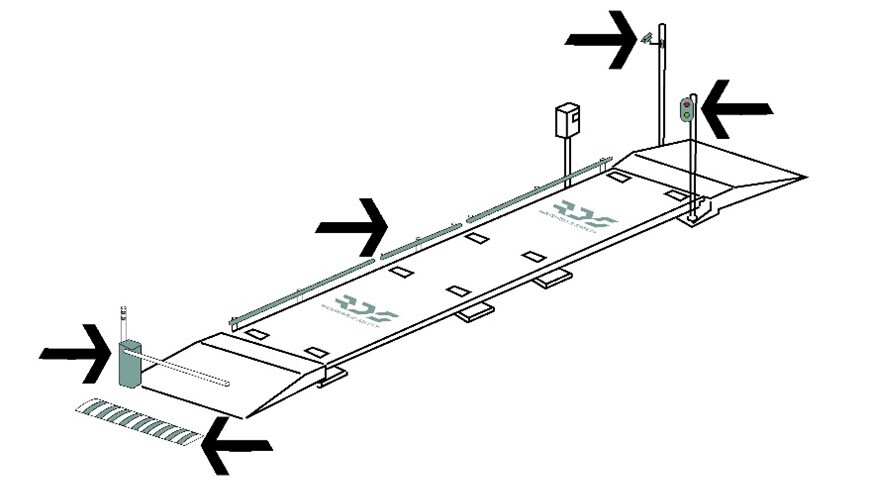
ONBOARD WEIGHING SYSTEMS
An onboard weighing system is a weighing solution mounted directly onto vehicles or machines (such as a truck or wheel loader). It measures the weight of loads while the vehicle is in operation, giving you immediate insight into loading levels and helping you prevent overloading.
Onboard systems can be used on many vehicles and machines, but compatibility depends on the type of vehicle, the axles and the weighing system. For certain applications, customisation is required to ensure optimal accuracy.
Modern onboard systems offer high accuracy, often within a few percent of the total load. Exact performance depends on the installation, the type of vehicle and regular maintenance.
Yes, calibration is necessary to ensure accurate measurements. This is typically done after installation and again whenever the system has been modified or relocated.
For systems used for commercial transactions or regulatory inspections, periodic calibration is required — often every two years, depending on usage and applicable regulations.
Yes, many modern onboard systems support integration with cloud platforms, including our own Kiloweb platform. This allows measurement data to be stored, analysed and shared in real time with administrative or management systems.
WEIGHING SOFTWARE | KILOWEB
Kiloweb records weighing data, manages databases and generates reports. It also supports the control of weighbridges, mobile weighing systems and peripheral equipment such as barriers, cameras or scanners.
Kiloweb can be integrated with ERP systems and other internal applications via a REST API. It also supports connections with regulatory platforms such as MATIS (OVAM), COPRO and Certipro. Mobile weighing systems such as the LM‑100 / Loadmaster Alpha 100 can also be connected.
Kiloweb is web‑based and can be used on any device with an internet connection, such as a PC, tablet or smartphone. A stable internet connection is recommended.
Yes, Kiloweb supports multiple users with different access rights and settings. Users can customise their dashboards and forms according to their needs.
Yes, Kiloweb can integrate mobile weighing systems. All required data — such as jobs and master data — is automatically sent to the system, and the results are returned to Kiloweb.
Yes, weigh tickets can be exported in various formats (e.g. PDF, Excel) and automatically sent to the relevant parties.
CALIBRATION | VERIFICATION
Weighing instruments used for commercial transactions must be calibrated before being put into service. After that, periodic re‑calibration is required according to legal regulations — typically every four years, depending on the type of instrument and its usage.
Calibration is the (internal) process of checking and, if necessary, adjusting a weighing instrument to ensure accurate measurements. Verification is a legal inspection carried out by an accredited body, during which the instrument is checked and officially approved for commercial use.
Verification must be carried out by an accredited organisation. RDS is itself an accredited verification service, recognised by Belac (NBN EN ISO/IEC 17020:2012 700‑INSP). Our certified technicians follow strict procedures to comply with all legal standards and regulations.
The cost of a verification depends on the type of weighing instrument, the required service and any additional tasks such as calibration or reporting. RDS offers tailored services to meet the specific needs of each company.
Using a non‑verified or outdated weighing instrument for commercial transactions can result in fines and sanctions from the competent authorities. It may also cause issues during quality inspections and negatively impact customer relationships.
After a successful verification, you will receive an official verification certificate confirming compliance with the legal standards. This document can be used for internal quality control or as proof during inspections by third parties.
RDS can perform verification on a wide range of weighing systems, including onboard weighing systems, weighbridges and platform scales. We also carry out inspections of non‑verified, non‑automatic weighing instruments at concrete and asphalt plants, in accordance with the applicable standards (TRA550, RN017, TRA21, RNR).
ANTI-COLLISION | ZONING
The DCS61‑S is an anti‑collision system developed by AMCS for tower and mobile cranes. The system helps prevent collisions by continuously monitoring crane movements and calculating safety zones in real time.
The system uses GPS to determine the position of mobile cranes and communicates with tower cranes via a radio network. When a mobile crane approaches a defined zone, a tower crane will automatically slow down or stop, while mobile cranes receive a warning. Zones can be configured in 3D.
Yes, the system is designed for both tower cranes and mobile cranes and can be applied to various crane types.
All crane data is continuously stored and can be accessed via USB or through the IoT Lifting web platform and mobile application. This enables remote monitoring, analysis and diagnostics.
A single network can manage up to 30 cranes, with 24 selective zones and 5 programmable targets.
CAMERA SYSTEMS | VISION SOLUTIONS
For tower cranes, hoist cranes and mobile cranes, we offer several visibility solutions, including Motec digital motor‑zoom cameras, the AMCS digital CAM61 system and the analogue LoadView cameras from Stoneridge | Orlaco. These systems give the operator a clear view of the hook, load and surroundings, enabling lifting operations to be carried out faster, safer and more independently.
Digital systems such as Motec and CAM61 provide higher image quality, better light sensitivity, powerful zoom and easy integration via Ethernet. Analogue systems such as LoadView are extremely robust, reliable and equipped with 40x optical zoom and autofocus. Digital systems offer the best image quality, while analogue systems excel in stability and simplicity.
Our forklift camera systems improve visibility of the forks, the load and the driving direction. The ForkView system shows exactly whether the forks are positioned correctly, while View‑on‑Forks provides a clear view of the fork tips when picking up and placing pallets. Both systems reduce damage, improve ergonomics and save time during every handling cycle.
For excavators, wheel loaders and other earthmoving machines, we offer 360° camera systems, FrontView cameras, SideEye cameras and RearView solutions. These systems are resistant to dust, mud, vibrations and extreme temperatures, and provide full visibility around the machine to help prevent accidents.
Person detection identifies pedestrians and vehicles in the danger zone and alerts the operator immediately. AI‑based variants distinguish people from objects, reducing false alarms. This increases safety in construction, logistics and industrial environments, and helps prevent accidents and downtime.
A blind‑spot camera, such as SideEye or CornerEye, gives the driver visibility of areas that are difficult or impossible to see with mirrors alone, such as the space next to the truck or diagonally in front of it. The system displays these zones in real time on a monitor in the cab, allowing cyclists, pedestrians and obstacles to be detected much earlier. This helps prevent accidents, supports safe manoeuvring in busy traffic and improves overall visibility around the vehicle — even in poor weather conditions or low light.
For port applications, we supply positioning cameras, Famos cameras and visibility solutions for ship‑to‑shore cranes. These systems support container handling, positioning and monitoring of critical zones. They are designed for heavy‑duty use in port environments and can be complemented with a 4G streamer for remote monitoring.
Many of our systems can be connected to existing monitors, displays, CAN‑bus networks or telematics platforms. Digital systems support Ethernet integration, while analogue systems are compatible with a wide range of industrial monitors. For each vehicle, we assess which integration is technically feasible and safe.
Our cameras are designed for industrial applications and feature high IP ratings, shock resistance and wide temperature tolerance. They continue to operate reliably in construction, earthmoving, logistics, agriculture and port environments — even in rain, dust, vibration or extreme temperatures.
The right choice depends on the type of machine, the visibility zones you want to improve, the environment and any safety requirements. We analyse your situation and recommend a solution that fits your workflow — whether that’s a hook camera, a 360° system, a blind‑spot camera, a forklift camera or an AI‑based detection system.
OBSTRUCTION LIGHTING
There are two main types of obstruction lighting: day and night lighting. Daytime lighting (medium intensity) uses high‑intensity white LED lights to remain visible in bright daylight. Night‑time lighting (low intensity) uses red LED lights that can operate continuously or in a flashing mode, depending on the configuration. Both types comply with the guidelines of the International Civil Aviation Organization (ICAO).
Yes. Obstruction lighting for cranes located near airports, heliports or other high‑risk areas must comply with the regulations of the ICAO (International Civil Aviation Organization). These regulations define, among other things, the colour, light intensity and visibility requirements of the beacons, both during the day and at night.
The day configuration uses high‑intensity white lighting (around 20,000 cd) to remain visible in sunlight, while the night configuration uses lower‑intensity red lighting (around 32 cd) to avoid glare. Some systems combine both functions in a single kit, automatically switching based on light conditions or time of day.
For night‑time obstruction lighting, typically three to four lights are installed: one on the top of the crane, one at the tip of the jib, and one or two on the counter‑jib or in the mast. The exact number and placement depend on the crane type and local safety regulations.
Yes. Using an integrated GPS module, the lights can be perfectly synchronised so that all beacons flash at the same moment. This increases visibility and prevents confusion with other light sources.
The systems use energy‑efficient LED technology with a lifespan of around 100,000 hours. As a result, power consumption is very low, ensuring sustainable and reliable operation — even during long‑term use or in extreme weather conditions.
ANEMOMETERS | WIND METERS
An anemometer primarily measures wind speed and, depending on the model, also wind direction and temperature. Some versions additionally record average and maximum wind speeds over a defined period and store this data on an SD card or via a cloud platform. This makes it possible to track trends and evaluate wind conditions with high accuracy.
Wind measurement is crucial for safety on construction sites and when operating cranes. Excessive wind speeds can affect the balance or stability of a crane, creating risks for both personnel and equipment. By continuously monitoring wind speed and setting alarm thresholds, operations can be halted in time when conditions become unsafe.
Most modern wind meters display data directly on a screen on the crane or inside the cab. Depending on the model, data can also be transmitted wirelessly to a web platform such as AnemoWeb, where wind speeds can be monitored in real time and viewed historically. Some devices additionally offer Bluetooth or WiFi connectivity, allowing measurements to be accessed via smartphone or computer.
Yes. To ensure continued measurement accuracy, periodic calibration is recommended. The sensors are wind‑tunnel calibrated during production, but factors such as relocation, contamination or wear can affect accuracy over time. Regular checks or re‑calibration ensure reliable readings, especially in applications where safety is critical.
Wind meters can be connected to various systems, such as displays, data loggers, alarm systems or cloud platforms. Through solutions like AnemoWeb, wind speeds can be monitored centrally, alarm notifications can be sent automatically via SMS or email, and reports can be exported. In addition, integrations are possible with XL colour displays, SMS modules or other site‑safety systems, ensuring all stakeholders are quickly informed when strong winds occur.